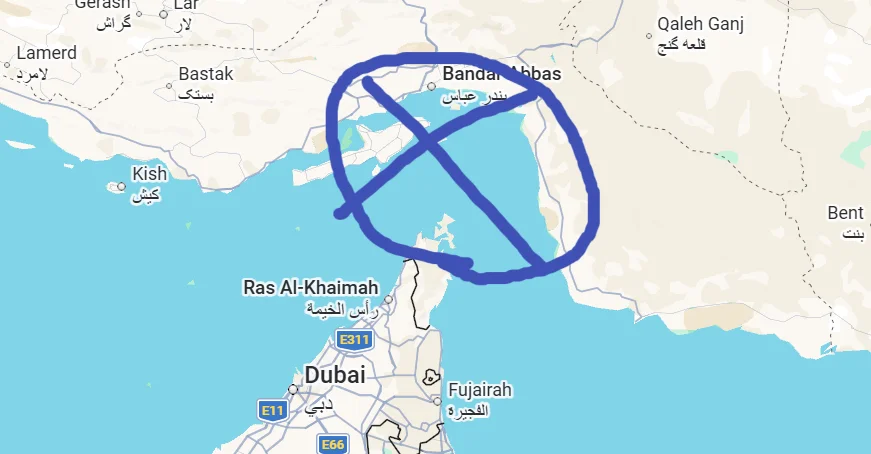
The world’s most important sea routes. The Strait of Hormuz is one of many possibilities of closing or blocking this waterway, known as the lifeline of the global economy, which means setting the world’s oil markets on fire and creating instability. A recent proposal from Trump centered on the blockade of the Strait of Hormuz. The issue has once again come to the center of global political discussion. In this critical situation, the world’s powerful countries and regional alliances have made their positions clear. Most countries believe that taking such a step would be extremely suicidal.
Spain’s tough stance
The strongest criticism on the issue so far has been made by Spanish Defense Minister Margarita Robles, who made it clear that Trump’s proposal had no logical basis. According to Spain, in such a sensitive area as the blockade of the Strait of Hormuz, it is foolish to even think about doing so. Margarita Robles made it clear that such a proposal by Trump makes no sense and is a major threat to international stability. Spain believes that provocative actions instead of diplomacy will only complicate the situation.
China’s restraint and interests
On the other hand, China, the world’s second-largest economy, has called for caution and calm on this issue. A large part of China’s energy imports come through this route. As a result, a blockade of the Strait of Hormuz impacts China’s economy. Beijing has said that it is in the common interest of the international community to keep the Strait of Hormuz open. China has urged all parties to exercise restraint and reminded them that freedom of navigation should not depend on the will or unwillingness of any single country.
ASEAN’s collective concern
ASEAN, a powerful alliance of 11 Southeast Asian nations, has expressed its deep concern over the issue. In a joint statement, ASEAN countries have called for the full and effective implementation of the ceasefire. According to them, ensuring maritime security and freedom of navigation and airspace is essential not only for the region but also for global trade. ASEAN countries believe that a blockade of the Strait of Hormuz, if this is done, will cause the supply chain around the world, including Asia, to collapse, which is not desirable in any way.
Diplomatic initiatives of France and the United Kingdom
Among the European powers, France and the United Kingdom have indicated that they will be directly involved in resolving the problem. blockade of the Strait of Hormuz. French President Emmanuel Macron said that they are working to restore freedom of navigation in the Strait of Hormuz. He said that France and the United Kingdom will organize an international conference in the coming days. The main purpose of this conference will be to bring the world’s powerful countries to one table and blockade the Strait of Hormuz, finding an effective solution to prevent it.
The new UK Prime Minister Keir Starmer has also made his position clear on this issue. He has clearly stated that the UK does not support any kind of blockade or provocative action. According to Starmer, there is no alternative to negotiations to maintain regional peace. This position of the UK proves that they are not willing to blindly accept all the proposals of their old ally America, especially when the issue of the blockade of the Strait of Hormuz is touchy like this.
Coordination of the European Union
The President of the European Commission, Ursula von der Leyen, noted that this crisis is essentially a matter of European security. She believes that freedom of navigation in the Strait of Hormuz is very important. According to her, this issue requires strong coordination between all EU countries, not just any single country. The EU believes that a blockade of the Strait of Hormuz, if such an incident occurs in the Strait of Hormuz, puts Europe’s energy security at extreme risk.
Why is this method so important?
For the convenience of readers, it is worth mentioning that the Strait of Hormuz is a narrow waterway between the Persian Gulf and the Gulf of Oman. About one-fifth of the world’s total extracted mineral oil is transported through this route. It is the main commercial route for oil-producing countries such as Saudi Arabia, Iran, the United Arab Emirates, Kuwait, and Iraq. As a result, a slight instability here means a sharp increase in oil prices in the world market. And if in the long run the blockade of the Strait of Hormuz persists, it could lead to a global economic recession.
History shows that any tension in this region divides world politics into two. In the past, with the blockade of the Strait of Hormuz, there have been demonstrations of strength in this system, but in the end, solutions have been found through negotiations. The conference called by France and the United Kingdom can play a very important role in the present time as well.
Finally, it can be said, “Blockade of the Strait of Hormuz.” The issue is no longer an internal matter of any particular country. It is a global crisis. If this waterway is closed due to Trump’s proposal or any other provocation, the common people will have to pay the price. It will have a negative impact on everything from the price of daily necessities to the cost of transportation. Therefore, the fact that world leaders are collectively talking about peace and freedom of navigation is very timely. This crisis should be resolved on the basis of international law and mutual respect. Analyzing of the impact and tensions of the 40-day Iran-US conflict: Damage, arms race and the path to peace
Source: BBC News
Stay tuned to MKSS News to get all the news first.