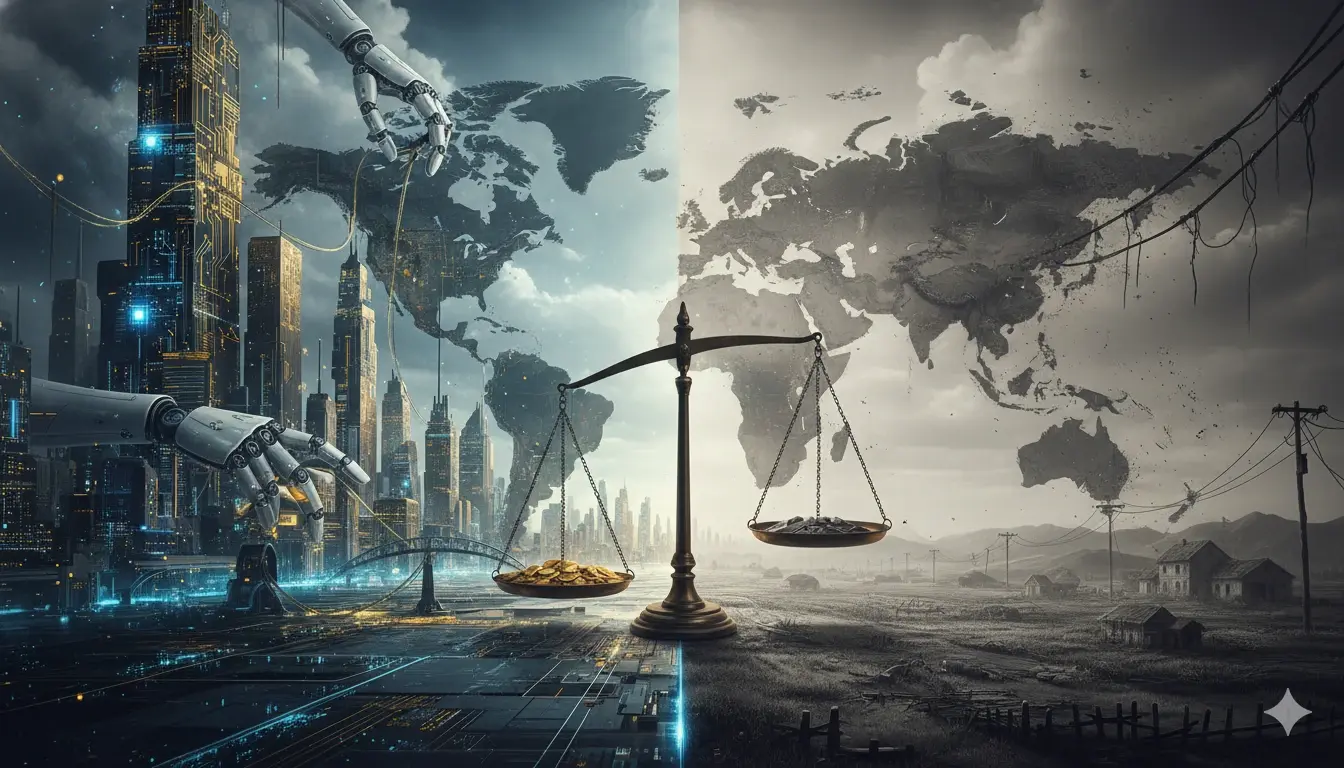
We often talk about the digital divide in terms of who has a laptop and who doesn’t. But as we move deeper into the 2020s, that discussion is starting to feel a bit outdated. The real wall being built today isn’t one of hardware; it’s one of code. As artificial intelligence moves from a novelty to a necessity, it’s impossible to ignore this reality. AI algorithmic inequality and the global wealth gap We are witnessing a shift where the wealthy own the predictive models, and the poor remain mere data points within them.
The invisible empire of information
In the old days, power was based on land, gold, or oil. If you had the wealth, you ran everything. But in this age of intelligence, data is the new sovereign. The problem is, this data is not being extracted equally. A few giant tech hubs in the global north have absorbed the world’s digital footprint over the past two decades. This concentrated ownership of data by a few tech giants illustrates how… AI algorithmic inequality and the global wealth gap This creates a vicious cycle where only those who have historical information can predict the future—and profit from it.
When a Silicon Valley algorithm decides which Kenyan agribusiness startup will get funding, it’s not just math that’s at work. It’s a specific cultural and economic perspective that may not understand local nuances. This disconnect is a silent but devastating driver of inequality.
The death of ‘labor benefits’
For decades, many developing countries had a reliable path to growth: capital in exchange for human labor. Factories, call centers, and basic manufacturing were the stepping stones to the middle class. But as machines become more intelligent and more capable of imitating cognitive tasks, that stepping stone is being torn down. This shift is a key driver. AI algorithmic inequality and the global wealth gap Because the conventional path to industrialization is being blocked by software that can do the job faster and cheaper than any human.
If a bot can handle customer service or simple coding tasks at a fraction of the cost of a human worker in Manila or Delhi, the economic benefits of those regions will evaporate overnight. We’re not just losing jobs; we’re losing the very process that helped poor countries become rich.
12 Banks’ Debt and Bangladesh Bank Liquidity Crisis
Symbolic bias and economic exclusion
Algorithms are often considered impartial judges, but they are actually like mirrors—they reflect the biases of their programmers. Most AI models today are trained on Western datasets, meaning they are “smart” on Western problems but “blind” on others. This bias runs deep. AI algorithmic inequality and the global wealth gap This makes it more difficult for people in emerging markets to get credit, insurance, or jobs, because automated systems do not recognize their unique identities.
According to research from the Brookings Institution The lack of diverse representation in the development of artificial intelligence could lead to a world where automated systems systematically exclude entire populations based on flawed and unrepresentative data.
Hardware Moat
Building world-class AI isn’t just about being smart; it requires powerful capabilities. The computing power required to train the latest models is enormous, requiring thousands of specialized GPUs, each costing thousands of dollars. The skyrocketing cost of this hardware means that only the richest countries and corporations can truly innovate. This structural barrier is a real one. AI algorithmic inequality and the global wealth gap Poor countries are being excluded from “AI-first” economies before they have a chance to type their first line of code.
Brainwashing 2.0
We have been hearing about ‘brain drain’ for years—that is, doctors and engineers moving to the West for better salaries. Artificial intelligence (AI) has given this a new dimension. A handful of global companies are poaching the most talented researchers from Africa, Southeast Asia, and Latin America. This brain drain is compounding the situation. AI algorithmic inequality and the global wealth gap Because the same people who could have created local, tailored solutions are now spending their days optimizing ad click or engagement algorithms for large global companies.
When a nation loses its ‘digital architects,’ it also loses the ability to shape its future. They become consumers rather than creators of technology.
Capital movement
In the world of high finance, milliseconds mean millions. An AI-powered trading algorithm can identify a trend and complete a million trades before a human can finish a cup of coffee. This speed advantage ensures that wealth naturally flows to those who already have the best technology. It is a systematic feature. AI algorithmic inequality and the global wealth gap Where the ‘small side’ or smaller emerging markets are playing a game they can never win. The market is no longer just ‘efficient’; it is specifically designed for those with the fastest code.
Digital colonialism and technology rent
We are entering an era of ‘digital rent.’ Instead of owning their own infrastructure, many countries are becoming mere customers of foreign platforms. Whether it’s cloud storage, productivity tools, or AI models, money is flowing out of the developing world and into the coffers of a few tech hubs. This relentless drain of capital defines… AI algorithmic inequality and the global wealth gap in the 21st century. It’s a modern method of extraction that doesn’t require ships or soldiers—just a monthly subscription fee.
Regulatory trap
Even trying to solve the problem can be counterproductive. As the world moves towards regulating artificial intelligence, the complexity of these laws can actually help large organizations. A large corporation has thousands of lawyers to deal with compliance issues; a small startup in a developing country does not. This ‘regulatory firewall’ is another layer. AI algorithmic inequality and the global wealth gap Ensuring that the status quo is unquestioned by new and diverse voices.
An impending financial crisis
Perhaps the most worrying part is the social safety net. If a rich country loses jobs to AI, they could (theoretically) tax AI companies to fund the social safety net. But what if the AI company isn’t based in your country? If a country’s economy is disrupted by foreign-owned AI, they won’t have any “AI dividends” to collect. This fiscal deficit is perhaps the most dangerous aspect. AI algorithmic inequality and the global wealth gap As a result, poor countries are the victims of all the chaos, but they have no revenue to deal with this disaster of AI algorithmic inequality and the global wealth gap
Towards a more just intelligence
Is the digital nightmare inevitable? Not necessarily. But to change its course, we need to be honest about what is happening. We need to understand its full scope. AI algorithmic inequality and the global wealth gap This is the first step towards a fairer digital future. We need a massive initiative for open-source AI, decentralized computing power, and ‘sovereign AI’ projects that will allow countries to determine their own intellectual destiny.
Finally, the ‘new world map’ is being drawn right now. It is not being drawn with ink on paper but with the parameters of a neural network. If we do not want a world that is permanently divided between masters of the machine and servants of the system, we must address its root causes. AI algorithmic inequality and the global wealth gap Before the ink dries on the new world map